Winterboer Agile Analytics

  • Services
    • Training
    • Consulting
  • About
    • Lynn Winterboer
    • Chad Winterboer
    • Katrina Starkweather
  • Testimonials
  • Events
  • Blog
  • Contact

October 10, 2016 by Lynn Winterboer 2 Comments

Test Automation: Agile Enablement for Data Warehousing and Business Intelligence Teams

Cher Fox and I recently presented at Agile2016 in Atlanta, GA. What an incredible experience! We are very fortunate that the Agile Alliance selected our session to video.

Our presentation is focused on test automation for DW/BI teams. Here’s what one attendee has to say about it:

During the Agile 2016 conference in Atlanta, I attended the Test Automation and Data Warehousing session with Lynn Winterboer and Cher Fox,” said Paul Carvalho, an Agile Coach at McKinsey & Company. “It was packed with insights into general trends and patterns for working with database teams, demos of working automation examples and an automated test dashboard, and interactive exercises to practice generating test cases for a Business Intelligence user scenario. Lynn and Cher brought their decades of combined practical experience to the audience in a value-packed interactive session that shows the tech industry where the gaps are and provides useful examples to help you get started on the path to automation. Test automation on data teams is a rare practice and yet is required to help lower risk and increase agility when working with databases and data warehousing projects. I highly recommend these two speakers and this session to other practitioners looking for good guidance for agility in the database and data warehousing fields.”

Paul’s insight into what the presentation communicated to him lets us know we are delivering news that’s relevant and necessary today. Test automation is a rare practice, but we really need to be doing it and it really is do-able.

About This Video

Test Automation: Agile Enablement for Data Warehousing and Business Intelligence Teams

Presenters: Cher Fox & Lynn Winterboer

If you’re an Agile Alliance member, you can watch the presentation from their website (link below). If you aren’t able to access the video, please reach out to me at [email protected] to see how else we can get this information into your hands!

Agile2016 Video


Here’s the summary we provided to the attendees about this video:

Regardless of whether your data warehousing (DW)/business intelligence (BI) team is dedicated to Scrum, a fan of Kanban, or focused on XP, “Agile” in any form calls for small increments of potentially deployable results – which means that QA is essential on a regular, frequent basis. As we develop these small increments, we need to not only test the new development, but also regression test what we’ve already built. Our test suite grows larger with each iteration, and manual testing quickly becomes infeasible. Agile requires that we automate our tests so that regression testing doesn’t become a development bottleneck.

Test automation is one of several key technical enablement practices that allows teams to be more successful in their agile journeys. While there are lots of test practices and automation tools out there for software development teams to leverage, very few are targeted to data-related development and testing. Agile analytics practitioner Lynn Winterboer and DW/BI architect and developer Cher Fox will share essential agile test foundations and data-focused test automation technologies to help data warehousing and business intelligence teams get a leg up on this important agile practice, including a demo of how this works!

Agenda

  • Why is test automation important for agile DW/BI teams?
  • Why aren’t all DW/BI teams automating their tests today?
  • What is the path to data-focused test automation?
  • Where to start? What tests to automate first?
  • Demo of a simple test automation tool any DW/BI team could build and use

About Agile Alliance

Agile Alliance is a nonprofit organization dedicated to promoting the concepts of Agile software development as outlined in the Agile Manifesto. With more than 30,000 members and subscribers around the globe, Agile Alliance is driven by the principles of Agile methodologies and the value delivered to developers, organizations, and end users. Agile Alliance organizes and supports events to bring the Agile community together on a global scale.

Are You Still Here?

Awesome! I’m glad you kept scrolling down the page. 🙂 I have a few bonus pictures for you from our visit to Agile2016.

agile2016-PaulCarvalho
Here we are at World of Coca-Cola at an Agile2016 event hosted by CA/Rally. Paul Carvalho stops for a Coke (and a smile!). He says, “Testers pick from the middle.”
agile2016-full-room
Yikes! It’s a full room. Lots of friendly faces, though, including Em Campbell-Pretty there on the far right.
agile2016-coach
I facilitated an Open Space session at Agile2016. A group of us had a conversation about Agile Data Warehousing and took some quick notes on what we discussed.
agile2016-Georgia Aquarium
Here I am with Chad Winterboer and Cher Fox cheesing for the camera. Well, I am, anyway. We are at the Georgia Aquarium during the closing conference party.

Thanks for visiting my blog! Contact me if you have any questions. Leave a comment below if you’d like to start a conversation with me and other visitors. Check out other blog posts or subscribe.
Filed Under: Blogs, Events, Favorites Tagged With: Sustainable Practice, Test Automation, Test Data, Testing

June 21, 2016 by Lynn Winterboer Leave a Comment

Best of TDWI – Second Year

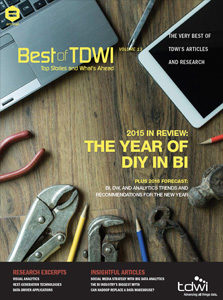
Best of TDWI, Volume 13

TDWI BOTDWI 2015The Year of DIY in BI

My TDWI Flashpoint article, “Kanban for Newly Agile Data Warehouse and Business Intelligence Teams,” was selected for The Data Warehouse Institute’s annual Best of TDWI, Volume 13, which published in mid-February. The Best of TDWI annual digital magazine features the most influential TDWI articles, research summaries, and newsletters from the previous year, as well as TDWI industry expert forecasts for the future of all things data. I am honored; this is my second year in a row to have one of my articles selected for this publication.

From TDWI: Looking Back to Look Forward

As surely as groundhogs predict the weather, February means it’s time for another issue of Best of TDWI: Top Stories and What’s Ahead, our annual compilation of some of TDWI’s best-received and most relevant articles, research, and information about all things data.

The past year saw BI take a step out of IT’s shadow and into the hands of business users with the progress of self-service data prep and engineering. That progress didn’t come without concerns, though, as conversations about good data governance and security in the age of IoT became more prominent.

Kanban for Newly Agile Data Warehouse and Business Intelligence Teams

By Lynn Winterboer

Agile Analytics Educator and Coach

Data teams brand-new to agile typically start by implementing the most popular agile framework, Scrum, hoping to achieve the success they’ve seen from their software brethren. The data warehouse and business intelligence (DW/BI) teams that are most successful with Scrum already have a robust infrastructure. They also have the technical discipline that enables push-button builds, continuous integration, automated testing, and production-quality testing. Continue Reading

Click here to read the Best of TDWI article from 2014, Why Build Architecturally Complete BI User Stories?

The original publication, reprinted with permission from 1105 Media, is located here: TDWI’s Best of TDWI Volume 13

Filed Under: Articles, Blogs, Recognition, TDWI Tagged With: Agile Transformation, Beginners, Kanban, Sustainable Practice

June 10, 2016 by Lynn Winterboer 1 Comment

Kanban for Newly Agile Data Warehouse and Business Intelligence Teams 

Data teams often start with Scrum. But, Kanban is a more effective framework.

By Lynn Winterboer, Agile Analytics Educator and Coach

Reprinted with the permission of 1105 Media, Inc.

Data teams brand-new to agile typically start by implementing the most popular agile framework, Scrum, hoping to achieve the success they’ve seen from their software brethren. The data warehouse and business intelligence (DW/BI) teams that are most successful with Scrum already have a robust infrastructure. They also have the technical discipline that enables push-button builds, continuous integration, automated testing, and production-quality testing.

However, I have found that most DW/BI teams do not have this type of infrastructure and technical discipline built out. Teams without these essential practices spend a majority of their Scrum sprint focused on manually managing builds, migrations, and testing, leaving little time for developing new, valuable DW/BI functionality.

I recommend that DW/BI teams new to agile evaluate several agile frameworks prior to choosing one. Certainly Scrum is a good candidate for some. Extreme Programming (XP) is another good candidate. This article describes another option, Kanban, which is very effective for teams disciplined enough to embrace it.

Kanban will help your team measure and incrementally improve your delivery approach. In my experience, the main benefits to a data team of using Kanban are the heavy use of metrics to drive improvement decisions (right up our alley!), its focus on reducing waste, and increased predictability.

Metrics

The foundation of Kanban is visualizing the work as it flows through the steps in the delivery process, measuring the time spent in each step along the way. Kanban leverages lean value-stream-mapping practices to measure the process cycle efficiency (PCE) of the DW/BI team’s delivery cycle. PCE is the time spent on value-added work as a percentage of the total time the request takes to become value for the organization. (See flowchart below.)

PCE Evaluation Flowchart


Reducing Waste

Measuring the PCE of each iteration of value provides the DW/BI team members with the metrics they need to reduce waste and get value into their stakeholder’s hands sooner. Metrics help the teams understand where their processes have bottlenecks (waiting) and inefficiencies (long duration for shorter amount of actual value creation). The goal is to see the amount of waste get smaller over time, thereby increasing PCE and delivering value faster. This is the kind of thing we want to see our organizations do using the information we provide them. It’s our turn to apply what we do well to our own delivery processes!

Two key ways DW/BI teams can reduce wasted time are by limiting work in process (WIP) and by making process improvements. Limiting WIP significantly reduces waiting time between steps in the process for a single iteration of value. By limiting WIP for a team, the organization makes a business decision to prioritize the delivery of value to the organization—over “100 percent utilization” of team member time. You can see in the flowchart above that this team is clearly not limiting WIP, because there is so much waiting time between steps and the duration of each step is much longer than the value creation time. For example, the reason the request sits in the “Development” step for 15 days, even though it only took 3 days of actual development time, is likely due to this team being spread across too many projects or tasks at one time. For a more detailed description of limiting WIP for DW/BI teams, see my article “Project Management: Do Less by Committing to More.”

In the meantime, there will be days when team members do not have useful project tasks to work on. This is the perfect time for them to make process improvements to their work, so the next time they will create value faster by spending less time waiting, manually handling automatable tasks, and expending unnecessary effort. For example, team members could focus on:

  • Researching and implementing a test automation framework
  • Building automatable regression tests for existing functionality
  • Learning about hyper-modeling approaches that allow for faster and more flexible changes as requirements evolve
  • Streamlining project documentation requirements
  • Automating build and deployment procedures for development, test, and production environments

Increasing Predictability

Measuring the team’s short increments allows the team to understand where waste is occurring and determine how long it takes, on average, to deliver business requests. The team can use these metrics to establish a “reality-based” expectation as to how long requests take from initial request to final production.

For example, a team could plot their complete cycle times (request through delivery of value) for all requests over a period of time on a scatter chart. From this, they might determine that 98 percent of requests are completed in 28 days or less. That metric implies that the organization this team supports can expect their requests to be met within 28 days for 98 percent of their requests.

Summary: The Choice Is Yours

Now that you have a sense for some of the key benefits of using Kanban in your agile approach to DW/BI, your team can decide for itself whether the metrics, improvements, and predictability inherent in Kanban are a good fit for your organization.

Lynn Winterboer teaches and coaches data warehouse and business intelligence (DW/BI) teams to effectively apply agile principles and practices to their work. For 20 years, Lynn has served in numerous roles on analytics and DW/BI teams. She understands the unique set of challenges faced by DW/BI teams who want to benefit from incremental agile project delivery. Clients include Capital One, Wal-Mart, Intel, Bankrate Insurance, CoBank, Sports Authority, Polycom, and McAfee.

Filed Under: Articles, Blogs, Favorites, TDWI Tagged With: Agile Transformation, Beginners, Feedback/Learning Cycles, Kanban, Sustainable Practice

September 10, 2014 by Lynn Winterboer Leave a Comment

Ten Mistakes to Avoid When Building a Sustainable Agile BI Practice

A few favorites from TDWI’s recent article on Agile BI.

TDWI (The Data Warehouse Institute) recently released a new article in their very useful “Ten Mistakes to Avoid” series.  Author Mark Giesbrecht from the Canadian National Railway outlines ten suggestions for a sustainable agile BI practice.  I am particularly fond of the following ideas presented in the article, and thought they would be useful to you as well:

PRODUCT OWNERSHIP: Sponsors often find it more difficult to free the Product Owner from a “day job” to focus on the project, than to get funding for the project!  A healthy agile BI team will, as Giesbrecht puts it,  “delay project start until the appropriate product owner commitment has been obtained.”

DESIGN: Giesbrecht provides a great analogy for just enough up front design: Watch out for urban sprawl where “project teams gravitate to the suburbs” (i.e. building new warehouse artifacts) over “gentrifying the existing neighborhoods and rehabilitating brown fields” (such as refactoring an existing fact or dimension to meet the needs of the existing and new development).

DEFINITION OF DONE: Be sure to include the support team’s perspective in the project team’s definition of done: Standards for naming conventions, as-built documentation, job flows, traceability, and restartability, to name a few, can greatly lower a solution’s TCO for little additional development cost.

AUTOMATION: Tools and automation can be very helpful to agile BI teams, including those that help with data profiling, data modeling, code version management, and testing automation. However, Giesbrecht makes it clear that “the choice of vendors is often less important than the process used to drive tool adoption.”

I believe these “Ten Mistakes” articles are only available for TDWI Premium Members, which I have been since 1999. If you are interested in these valuable resources and aren’t yet a TDWI member – I encourage you to join and gain the benefits of this very useful and established data-focused industry organization.

I will be teaching Agile Analytics: Road Mapping, Chartering, and Release Planning on Monday, September 22, 2014 at the upcoming TDWI World Conference in San Diego – Hope to see you there!

Also, check out Dr. Ken Collier’s Ten Mistakes in an Agile BI Transformation.

Filed Under: Blogs, Review, TDWI Tagged With: Definition of Done, Enabling Infrastructure, Sustainable Practice, Up Front Design

Search This Website

SiteLock

Events

  • Lynn Hosts: Agile Denver DW/BI March Meetup Mar 23, 2017
  • Agile Denver March Meetup Mar 27, 2017
  • Agile Games and Mob Programming 2017 Conferences Apr 03, 2017

About Us

Winterboer Agile Analytics provides training, coaching and consulting for data warehousing and business intelligence. We are located in Denver, CO.
Contact Us

© 2017 · www.WinterboerAgileAnalytics.com · Created and Managed Starkweather Marketing, LLC