Winterboer Agile Analytics

  • Services
    • Training
    • Consulting
  • About
    • Lynn Winterboer
    • Chad Winterboer
    • Katrina Starkweather
  • Testimonials
  • Events
  • Blog
  • Contact

July 21, 2016 by Lynn Winterboer 1 Comment

What’s Hot: My Recommendations for Agile 2016 – Part 3

Agile 2016 | July 25 – 29 Atlanta, GA

The Agile 2016 Conference in Atlanta is right around the corner! The forecast for July 25 is … 96 degrees with high humidity. It’s a good thing I’ll be inside, where it’s air conditioned, and enjoying the amazing lineup at this year’s conference. I’ve been using my blog to post my recommendations. I’ve shared my stories and thoughts on each day, if you missed them check out: Monday, July 25 and/or Tuesday, July 26.

Now, on to Wednesday, July 27.

The Journey from Monolith to Microservices: A Guided Adventure (Mike Gehard)

I’m really interested in the application of the “microservices” ideas to data warehousing.

Failing @ Scaling: Don’t Panic, and Carry a Towel (Em Campbell-Pretty)

Two of my favorite things – Em Campbell-Pretty talking Agile at scale, and The Hitchiker’s Guide to the Universe! Doesn’t get much better than that!

Value mapping with fewer dollars and more sense (Natalie Warnert)

I’ve known Natalie for several years and seen her present a few times. She’s got a lot of knowledge on and passion for her topics, and always brings something useful to the conference. This is a good topic that will give participants a lot to think about.

Intentional Learning – Map a Successful Strategy (JoEllen Carter, Claire Moss)

A core aspect of Agile is continuous improvement – for individuals as well as teams and systems. I’ve known JoEllen for several years and am confident this will be useful for attendees.

The Fast Foundation Workshop: Setting Up Projects for Success (Jeremy Kriegel)

I first met Jeremy, a creative, kind and knowledgeable UX guy, at Agile 2013 in Nashville – he was wearing one of the coolest pairs of glasses I’ve ever seen! The conversation took off from there, and we became friends. I like the premise of this session and know I’ll learn something new about “just enough” design up front.

Delivering BI projects using Agile (Syed Rayhan, Gurushyam Mony)

Of course I look forward to this session!

Agile Architect – Turning Followers into Leaders (Chris Edwards)

Architecture is so important, and yet a bit difficult to frame in an Agile approach. I know our team will benefit from learning about intent-based leadership.

Jumping off the hamster wheel with Kanban (Julia Wester, Anna Kovats)

I’m very happy to see more sessions on Kanban and limiting WIP at this conference!

Didn’t I say there are a lot of amazing sessions this year at Agile 2016? My next post will cover all of the Agile 2016 events scheduled for Thursday. If you aren’t already subscribed to my blog, sign up now!

Q: Which events are you attending? Tweet me @agilelynn and let’s connect.
Q: Which events do you recommend and why?

UPDATE:

My Recommendations & Stories for Agile 2016 Day 4 are HERE.
Filed Under: Blogs, Events, Presenting, Review Tagged With: Agile Transformation, Architecture, Beginners, Feedback/Learning Cycles, Kanban

June 21, 2016 by Lynn Winterboer Leave a Comment

Best of TDWI – Second Year

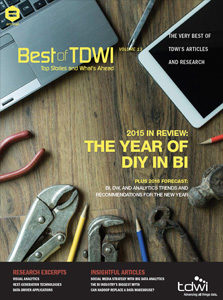
Best of TDWI, Volume 13

TDWI BOTDWI 2015The Year of DIY in BI

My TDWI Flashpoint article, “Kanban for Newly Agile Data Warehouse and Business Intelligence Teams,” was selected for The Data Warehouse Institute’s annual Best of TDWI, Volume 13, which published in mid-February. The Best of TDWI annual digital magazine features the most influential TDWI articles, research summaries, and newsletters from the previous year, as well as TDWI industry expert forecasts for the future of all things data. I am honored; this is my second year in a row to have one of my articles selected for this publication.

From TDWI: Looking Back to Look Forward

As surely as groundhogs predict the weather, February means it’s time for another issue of Best of TDWI: Top Stories and What’s Ahead, our annual compilation of some of TDWI’s best-received and most relevant articles, research, and information about all things data.

The past year saw BI take a step out of IT’s shadow and into the hands of business users with the progress of self-service data prep and engineering. That progress didn’t come without concerns, though, as conversations about good data governance and security in the age of IoT became more prominent.

Kanban for Newly Agile Data Warehouse and Business Intelligence Teams

By Lynn Winterboer

Agile Analytics Educator and Coach

Data teams brand-new to agile typically start by implementing the most popular agile framework, Scrum, hoping to achieve the success they’ve seen from their software brethren. The data warehouse and business intelligence (DW/BI) teams that are most successful with Scrum already have a robust infrastructure. They also have the technical discipline that enables push-button builds, continuous integration, automated testing, and production-quality testing. Continue Reading

Click here to read the Best of TDWI article from 2014, Why Build Architecturally Complete BI User Stories?

The original publication, reprinted with permission from 1105 Media, is located here: TDWI’s Best of TDWI Volume 13

Filed Under: Articles, Blogs, Recognition, TDWI Tagged With: Agile Transformation, Beginners, Kanban, Sustainable Practice

June 10, 2016 by Lynn Winterboer 1 Comment

Kanban for Newly Agile Data Warehouse and Business Intelligence Teams 

Data teams often start with Scrum. But, Kanban is a more effective framework.

By Lynn Winterboer, Agile Analytics Educator and Coach

Reprinted with the permission of 1105 Media, Inc.

Data teams brand-new to agile typically start by implementing the most popular agile framework, Scrum, hoping to achieve the success they’ve seen from their software brethren. The data warehouse and business intelligence (DW/BI) teams that are most successful with Scrum already have a robust infrastructure. They also have the technical discipline that enables push-button builds, continuous integration, automated testing, and production-quality testing.

However, I have found that most DW/BI teams do not have this type of infrastructure and technical discipline built out. Teams without these essential practices spend a majority of their Scrum sprint focused on manually managing builds, migrations, and testing, leaving little time for developing new, valuable DW/BI functionality.

I recommend that DW/BI teams new to agile evaluate several agile frameworks prior to choosing one. Certainly Scrum is a good candidate for some. Extreme Programming (XP) is another good candidate. This article describes another option, Kanban, which is very effective for teams disciplined enough to embrace it.

Kanban will help your team measure and incrementally improve your delivery approach. In my experience, the main benefits to a data team of using Kanban are the heavy use of metrics to drive improvement decisions (right up our alley!), its focus on reducing waste, and increased predictability.

Metrics

The foundation of Kanban is visualizing the work as it flows through the steps in the delivery process, measuring the time spent in each step along the way. Kanban leverages lean value-stream-mapping practices to measure the process cycle efficiency (PCE) of the DW/BI team’s delivery cycle. PCE is the time spent on value-added work as a percentage of the total time the request takes to become value for the organization. (See flowchart below.)

PCE Evaluation Flowchart


Reducing Waste

Measuring the PCE of each iteration of value provides the DW/BI team members with the metrics they need to reduce waste and get value into their stakeholder’s hands sooner. Metrics help the teams understand where their processes have bottlenecks (waiting) and inefficiencies (long duration for shorter amount of actual value creation). The goal is to see the amount of waste get smaller over time, thereby increasing PCE and delivering value faster. This is the kind of thing we want to see our organizations do using the information we provide them. It’s our turn to apply what we do well to our own delivery processes!

Two key ways DW/BI teams can reduce wasted time are by limiting work in process (WIP) and by making process improvements. Limiting WIP significantly reduces waiting time between steps in the process for a single iteration of value. By limiting WIP for a team, the organization makes a business decision to prioritize the delivery of value to the organization—over “100 percent utilization” of team member time. You can see in the flowchart above that this team is clearly not limiting WIP, because there is so much waiting time between steps and the duration of each step is much longer than the value creation time. For example, the reason the request sits in the “Development” step for 15 days, even though it only took 3 days of actual development time, is likely due to this team being spread across too many projects or tasks at one time. For a more detailed description of limiting WIP for DW/BI teams, see my article “Project Management: Do Less by Committing to More.”

In the meantime, there will be days when team members do not have useful project tasks to work on. This is the perfect time for them to make process improvements to their work, so the next time they will create value faster by spending less time waiting, manually handling automatable tasks, and expending unnecessary effort. For example, team members could focus on:

  • Researching and implementing a test automation framework
  • Building automatable regression tests for existing functionality
  • Learning about hyper-modeling approaches that allow for faster and more flexible changes as requirements evolve
  • Streamlining project documentation requirements
  • Automating build and deployment procedures for development, test, and production environments

Increasing Predictability

Measuring the team’s short increments allows the team to understand where waste is occurring and determine how long it takes, on average, to deliver business requests. The team can use these metrics to establish a “reality-based” expectation as to how long requests take from initial request to final production.

For example, a team could plot their complete cycle times (request through delivery of value) for all requests over a period of time on a scatter chart. From this, they might determine that 98 percent of requests are completed in 28 days or less. That metric implies that the organization this team supports can expect their requests to be met within 28 days for 98 percent of their requests.

Summary: The Choice Is Yours

Now that you have a sense for some of the key benefits of using Kanban in your agile approach to DW/BI, your team can decide for itself whether the metrics, improvements, and predictability inherent in Kanban are a good fit for your organization.

Lynn Winterboer teaches and coaches data warehouse and business intelligence (DW/BI) teams to effectively apply agile principles and practices to their work. For 20 years, Lynn has served in numerous roles on analytics and DW/BI teams. She understands the unique set of challenges faced by DW/BI teams who want to benefit from incremental agile project delivery. Clients include Capital One, Wal-Mart, Intel, Bankrate Insurance, CoBank, Sports Authority, Polycom, and McAfee.

Filed Under: Articles, Blogs, Favorites, TDWI Tagged With: Agile Transformation, Beginners, Feedback/Learning Cycles, Kanban, Sustainable Practice

August 7, 2013 by Lynn Winterboer Leave a Comment

Agile Development Methodologies & Book Recommendations

Where to Start…

Wordleforblog
A friend, who I met at a data geek conference last year, recently emailed me for advice:

“Hi Lynn,

Do you have a recommendation for a good book (or two) about agile development methodologies? I’m trying to get more formal development processes in place here, and I’ve read through most of the Wikipedia articles. I’m looking for something with a little more meat, and maybe some real-world examples. A lot of the focus seems to be on scrum. Is that the predominant agile method that people find most effective? I also saw literature about XP and Kanban. Do you have any opinions on the good and the bad about these other ones? Thanks for your advice, I really appreciate getting your perspective.” [Read more…]

Filed Under: Blogs, Review Tagged With: Beginners, eXtreme Programming, Jim Highsmith, Kanban, Ken Collier, Mike Cohn, Project Management, Scott Ambler, Scrum

Search This Website

SiteLock

Events

  • Lynn Hosts: Agile Denver DW/BI March Meetup Mar 23, 2017
  • Agile Denver March Meetup Mar 27, 2017
  • Agile Games and Mob Programming 2017 Conferences Apr 03, 2017

About Us

Winterboer Agile Analytics provides training, coaching and consulting for data warehousing and business intelligence. We are located in Denver, CO.
Contact Us

© 2017 · www.WinterboerAgileAnalytics.com · Created and Managed Starkweather Marketing, LLC