Winterboer Agile Analytics

  • Services
    • Training
    • Consulting
  • About
    • Lynn Winterboer
    • Chad Winterboer
    • Katrina Starkweather
  • Testimonials
  • Events
  • Blog
  • Contact

September 7, 2016 by Lynn Winterboer 1 Comment

Review of Scott Ambler’s Agile Database Techniques Stack

The Agile Database Techniques Stack: Bridging the Agile/Data Cultural Divide Presented by Scott Ambler Monday, July 25, 106 at Agile2016 in Atlanta, Georgia

Review by Joe Bernardini

One of the best, most enlightening sessions I attended at Agile 2016 was Scott Ambler’s session on “The Agile Database Techniques Stack.” The theme of the presentation was the difference, or as Scott stated, the chasm between the Dev Ops development process and the processes used in data warehouse / business Intelligence applications.

This chart* graphically showed this point:

Database Techniques Stack Cultural Impedance Mismatch

*Source: Agiledata.org/essays/culturalImpedanceMismatch.html © Disciplined Agile Consortium

The question then is: “Why is there this chasm, and how do we as DW/BI professionals close this gap?”

Here’s Why:

  • Rigid data organizations
  • Developers don’t speak data, and data people don’t know development
  • BRUF – Big Requirements Up Front
  • Lack of Data Testing – data not treated as the asset as it is described
  • Traditional Change management is actually change prevention, stifling Continuous Integration
  • Lost sight of real goal to fulfill stakeholder’s needs
  • No strategy to address data quality issues

How We Can Fix This:

  • Work Collaboratively – pair / mob development
  • Embrace changing requirements
  • Adapt usage driven development – data usage is more important than data structures, “user stories drive development, not data models”
  • Deliver incrementally

Evolutionary Approach by Ambler

  • Pay down technical debt – refactor, work to change the T in ETL from Big T to Little T
  • Be pragmatic – one version of the truth may not be an answer
  • Create light weight and valuable artifacts

Create Lightweight and Valuable Artifacts Ambler

The Agile Database Techniques Stack, developed by Scott, includes the following:

  • Vertical Slicing
  • Clean Architecture and Design
  • Agile Data Modeling
  • Database Refactoring
  • Database Regression Testing
  • Continuous Database Integration
  • Configuration Management

Vertical Slices of a Solution

Every iteration of an agile team produces a working solution. The functionality is added vertically, in vertical slices. He gave examples of slicing strategies for DW/BI: one new element from a single data source, one new data element from several sources, a change to an existing report, a new report, a new reporting view and a new data mart table.

Scott reviewed considerations or clean data architecture. I won’t go into that here, but will list them:

  • Create Clean Data Architecture
  • Consistency
  • Solution Fit
  • Latency
  • Security
  • Scalability

Then he discussed strategies for Clean Database Design(here’s a quick overview)

  • Normalization understanding (are you storing data in one and one-only place?)
  • Design for Database Type – OLTP (transactional -> normalized design) and OLAP (analytical -> denormalized design)
  • Tables and columns should be cohesive
  • Future Proof – Historical values, soft/hard deletes, unique surrogate key, all relationships many-to-many
  • Set and follow naming conventions

Agile Data Modeling is a concept. Rather than starting development from a fully completed detail data model, the agile data modelling process flows from Conceptual Model to a Detailed Physical Model – where ddl is created and development starts, followed by rounds of iterative development and testing of data usage, after which a detailed data specification is completed.  Data modeling, says Scott, is an act of exploring data-oriented structures. It should be evolutionary and incremental, focused on data usage, and should be done collaboratively.

High-level conceptual -> detailed physical (ddl) -> detailed specification

Scott listed and discussed several other agile database techniques. These included: refactoring and regression testing. Refactoring is simple change to a database schema that improves it design while retaining both its behavioral and informational semantics. He has a very good book on this, “Refactoring Databases,” that goes into a lot more detail. In regression testing, he pointed out that as agilists we develop regression unit and acceptance test suites for our applications, so why would we not also do this for databases? He also believes that database testing at the black-box level (which is just a starting point) is really not enough. He is supportive of Test/Behavior Driven Database Development as a practical approach to ensuring database quality, but it’s not a stand-alone activity. He also likes Continuous Integration and Databases, but did say that there is no good one tool solution and that the increase use of mocks may be required.  In Configuration Management, Scott is a proponent of keeping all work products in a versioned repository, this includes database objects. He gave several good reasons why we should do it this way, including the fact that it maintains the integrity of the system and all supporting work products as they evolve.

Overall, Scott Ambler and this session, stimulated my thinking about the challenges in using Agile in a Data Warehouse / Business Intelligence environment.  He was honest about the barriers in the way, but gave a vision and techniques to move BI into an Agile development world.

See the full description and obtain a PDF of his presentation: The Agile Database Techniques Stack: Bridging the Agile/Data Cultural Divide 
Filed Under: Blogs Tagged With: Behavior-Driven Development (BDD), Scott Ambler, Testing

September 17, 2014 by Lynn Winterboer Leave a Comment

BI Definition of Ready

What to include in the BI Definition of Ready

In an online forum, someone recently asked:

  1. What’s in your Definition of Ready?
  2. When does the ‘ready’ criteria apply? — i.e. ready by the end of Sprint Planning (How) or ready for the beginning of Sprint Planning?

Here are the thoughts I shared with that group.

[Read more…]

Filed Under: Blogs, Q&A Tagged With: Acceptance Criteria, Behavior-Driven Development (BDD), Definition of Ready, Retrospectives, Story Refinement, User Stories

May 23, 2014 by Lynn Winterboer Leave a Comment

Acceptance Criteria in Agile User Stories

How to Create Valuable User Stories

Get Your Testers Involved in Acceptance Criteria

FOUR FREQUENTLY ASKED QUESTIONS

I recently had the honor of presenting a series of webinars on “Writing User Stories and Slicing Epics for DW/BI Teams” for Cutter Consortium, where I am a senior consultant. After each webinar, I addressed questions from the audience. I’ve been sharing my answers in my blog.

Here’s another popular question and my answer.

Question #3: “What’s an example of good acceptance criteria — outside of that the report should match the mockup/data should be accurate.”

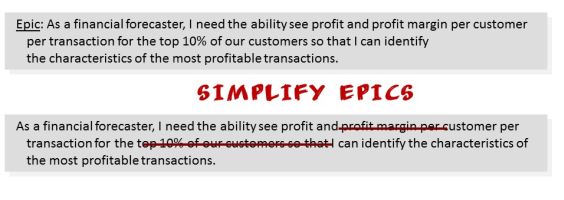
LW: Acceptance criteria is a big topic. A simple example can be seen in figure 2, in the most profitable transactions.

Simplify Epics Figure 2Figure 2 — Watch Out for Epics

We’ve simplified it down to where we need to see profit per customer per transaction, so that we can identify the characteristics of the most profitable transactions. One example is when XZY manufacturing places order number 13579 for 3 widgets for $100 each. This is our acceptance criteria. They’ve placed an order for 3 of our products at $100 each, and the widgets are on sale for 10% off, and the cost of goods sold for each widget is $50, then the profit for this order should be $120.

If you do the math, that works out that $300 less 10% ($30) less $150 = $120. This is what’s called behavior-driven development. This is a format. When something happens, and it has X criteria, and it also has Y criteria, then Z happens. It’s a great method in the data world for the stakeholders and product owner to clarify what they mean and what they’re expecting to see. In this case, you might have several different scenarios — and this could come out of a use case scenario — so you might have a handful of these examples.

And I like it when the person requesting this, the stakeholder, comes to me and says, “Okay, here are five orders that I’ve picked out of our system and they each meet a different criteria. This one has 10% off. This one has $5.00 off each. This one doesn’t have any discounts.”

And you would even want one that says, “If the cost of the product, less the discount, less the cost of goods sold, is negative, we want to know that it was a negative profit.”

So it’s good to come up with a handful of examples that flesh out what they want to see. It gives you test data to unit test on, and you can automate that. So when you have an actual order, where they say, “Run this through and here’s what I expect the profit number to be,” then you can automate that very easily. You can say, “Here’s the input of this order with these elements and here’s the expected profit that’s going to calculate in the end.”

That’s a beautiful way to go.

However, it is very time consuming. And it can feel completely overwhelming to some teams who aren’t set up to do that. It’s very useful to have the testers involved, or someone with testing skills involved because he or she can say, “I see your story, here. Let’s pull a few orders out that meet these scenarios.” The testers can get going on writing the tests and getting the test data set up and automating those tests right away before the developer even does any development.

That’s a great way to do it.


COMING UP ON LYNN’S BLOG:

LYNN ANSWERS THIS POPULAR QUESTION:

Q4: What is your recommended sprint length for a data warehouse team given the fact that it takes longer to deliver a Data warehouse solution?

Share in the Comments:

Do you have a tester you can include on your team from the beginning? How are your stories? Do you wonder if you have an epic? Post your story here and let’s discuss as a community.


Filed Under: Blogs, Cutter, Q&A Tagged With: Acceptance Criteria, Behavior-Driven Development (BDD), Test Automation, Test Data, Testers, Unit Testing, User Stories

Search This Website

SiteLock

Events

  • Lynn Hosts: Agile Denver DW/BI March Meetup Mar 23, 2017
  • Agile Denver March Meetup Mar 27, 2017
  • Agile Games and Mob Programming 2017 Conferences Apr 03, 2017

About Us

Winterboer Agile Analytics provides training, coaching and consulting for data warehousing and business intelligence. We are located in Denver, CO.
Contact Us

© 2017 · www.WinterboerAgileAnalytics.com · Created and Managed Starkweather Marketing, LLC