Winterboer Agile Analytics

  • Services
    • Training
    • Consulting
  • About
    • Lynn Winterboer
    • Chad Winterboer
    • Katrina Starkweather
  • Testimonials
  • Events
  • Blog
  • Contact

September 17, 2014 by Lynn Winterboer Leave a Comment

BI Definition of Ready

What to include in the BI Definition of Ready

In an online forum, someone recently asked:

  1. What’s in your Definition of Ready?
  2. When does the ‘ready’ criteria apply? — i.e. ready by the end of Sprint Planning (How) or ready for the beginning of Sprint Planning?

Here are the thoughts I shared with that group.

[Read more…]

Filed Under: Blogs, Q&A Tagged With: Acceptance Criteria, Behavior-Driven Development (BDD), Definition of Ready, Retrospectives, Story Refinement, User Stories

June 3, 2014 by Lynn Winterboer Leave a Comment

Hard to Find Experienced Product Owners

Why is It So Hard to Find Experienced Product Owners?

Guest Blogger - Lynn Winterboer

I was honored to guest blog recently for Coaching Agile Teams by Lyssa Adkins.  Here’s an excerpt of the blog and then a link to her website so you can read the rest of it!

I have noticed a recent increase in the number of recruiters contacting me for Product Owner roles, many of them looking for someone to work with a data-focused team (my area of expertise).  I just chatted with a recruiter looking for an experienced product owner (PO) to work with a healthcare company’s analytics team in the Denver Tech Center area. (Know anyone?) We both bemoaned the fact that there aren’t many experienced POs available in the market, much less any who have a good background in working with data warehousing/business intelligence/analytics. I can imagine other teams struggle to find product owners with the right amount of experience in their industry or business function.

If you are looking to hire product owners for your analytics team, and can’t find the perfect person on the market, I have an idea for you.

Step 1: Find someone who has the right experience as an analytics business analyst and WANTS to work in an Agile framework:

Continued at Coaching Agile Teams…

Filed Under: Agile Coaching Institute, Blogs, Favorites Tagged With: Acceptance Criteria, Agile Values and Principles, Build the RIGHT THING, Business Value, Multiple Business Domains, Organization Priorities, Team Priorities

May 23, 2014 by Lynn Winterboer Leave a Comment

Acceptance Criteria in Agile User Stories

How to Create Valuable User Stories

Get Your Testers Involved in Acceptance Criteria

FOUR FREQUENTLY ASKED QUESTIONS

I recently had the honor of presenting a series of webinars on “Writing User Stories and Slicing Epics for DW/BI Teams” for Cutter Consortium, where I am a senior consultant. After each webinar, I addressed questions from the audience. I’ve been sharing my answers in my blog.

Here’s another popular question and my answer.

Question #3: “What’s an example of good acceptance criteria — outside of that the report should match the mockup/data should be accurate.”

LW: Acceptance criteria is a big topic. A simple example can be seen in figure 2, in the most profitable transactions.

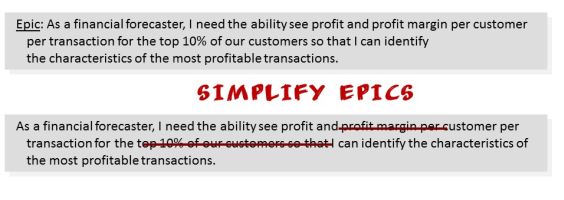
Simplify Epics Figure 2Figure 2 — Watch Out for Epics

We’ve simplified it down to where we need to see profit per customer per transaction, so that we can identify the characteristics of the most profitable transactions. One example is when XZY manufacturing places order number 13579 for 3 widgets for $100 each. This is our acceptance criteria. They’ve placed an order for 3 of our products at $100 each, and the widgets are on sale for 10% off, and the cost of goods sold for each widget is $50, then the profit for this order should be $120.

If you do the math, that works out that $300 less 10% ($30) less $150 = $120. This is what’s called behavior-driven development. This is a format. When something happens, and it has X criteria, and it also has Y criteria, then Z happens. It’s a great method in the data world for the stakeholders and product owner to clarify what they mean and what they’re expecting to see. In this case, you might have several different scenarios — and this could come out of a use case scenario — so you might have a handful of these examples.

And I like it when the person requesting this, the stakeholder, comes to me and says, “Okay, here are five orders that I’ve picked out of our system and they each meet a different criteria. This one has 10% off. This one has $5.00 off each. This one doesn’t have any discounts.”

And you would even want one that says, “If the cost of the product, less the discount, less the cost of goods sold, is negative, we want to know that it was a negative profit.”

So it’s good to come up with a handful of examples that flesh out what they want to see. It gives you test data to unit test on, and you can automate that. So when you have an actual order, where they say, “Run this through and here’s what I expect the profit number to be,” then you can automate that very easily. You can say, “Here’s the input of this order with these elements and here’s the expected profit that’s going to calculate in the end.”

That’s a beautiful way to go.

However, it is very time consuming. And it can feel completely overwhelming to some teams who aren’t set up to do that. It’s very useful to have the testers involved, or someone with testing skills involved because he or she can say, “I see your story, here. Let’s pull a few orders out that meet these scenarios.” The testers can get going on writing the tests and getting the test data set up and automating those tests right away before the developer even does any development.

That’s a great way to do it.


COMING UP ON LYNN’S BLOG:

LYNN ANSWERS THIS POPULAR QUESTION:

Q4: What is your recommended sprint length for a data warehouse team given the fact that it takes longer to deliver a Data warehouse solution?

Share in the Comments:

Do you have a tester you can include on your team from the beginning? How are your stories? Do you wonder if you have an epic? Post your story here and let’s discuss as a community.


Filed Under: Blogs, Cutter, Q&A Tagged With: Acceptance Criteria, Behavior-Driven Development (BDD), Test Automation, Test Data, Testers, Unit Testing, User Stories

January 29, 2014 by Lynn Winterboer Leave a Comment

Agile DW/BI Testing

Agile DW/BI Testing — Just Get Started!

by Ken Collier and Lynn Winterboer

This article was first published in TDWI BI This Week on July 9, 2013

[TDWI Editor’s note: Lynn Winterboer and Ken Collier are leading a session at the TDWI World Conference in San Diego (August 18-23, 2013), Agile BI: Test Automation and Test-Driven Database Development. We asked them to share a realistic scenario of how agile testing works in the real world.] [Read more…]

Filed Under: Articles, TDWI Tagged With: Acceptance Criteria, Automated Testing, Feedback/Learning Cycles, Ken Collier, Quality, Test Data, Testing

Search This Website

SiteLock

Events

  • Lynn Hosts: Agile Denver DW/BI March Meetup Mar 23, 2017
  • Agile Denver March Meetup Mar 27, 2017
  • Agile Games and Mob Programming 2017 Conferences Apr 03, 2017

About Us

Winterboer Agile Analytics provides training, coaching and consulting for data warehousing and business intelligence. We are located in Denver, CO.
Contact Us

© 2017 · www.WinterboerAgileAnalytics.com · Created and Managed Starkweather Marketing, LLC